
Solution Overview
This solution focuses on prototyping medical-image review workflows for research and workflow validation. Any clinical use, model evaluation or regulatory work would require a separately agreed scope and specialist review.
The Challenge
Questions to resolve before committing to scope:
- What data is authorised for this prototype?
- Who can access images and review notes?
- Which workflow decisions remain with qualified professionals?
Delivery approach
- Define intended use: Agree on prototype limits, permitted datasets and data-handling responsibilities.
- Prototype the review flow: Explore image navigation, notes and work queues using permitted test data; collect feedback from reviewers.
- Evaluate the workflow: Document usability findings, access-control tests and unresolved questions before considering further development.
Inside the solution
From workflow to system design
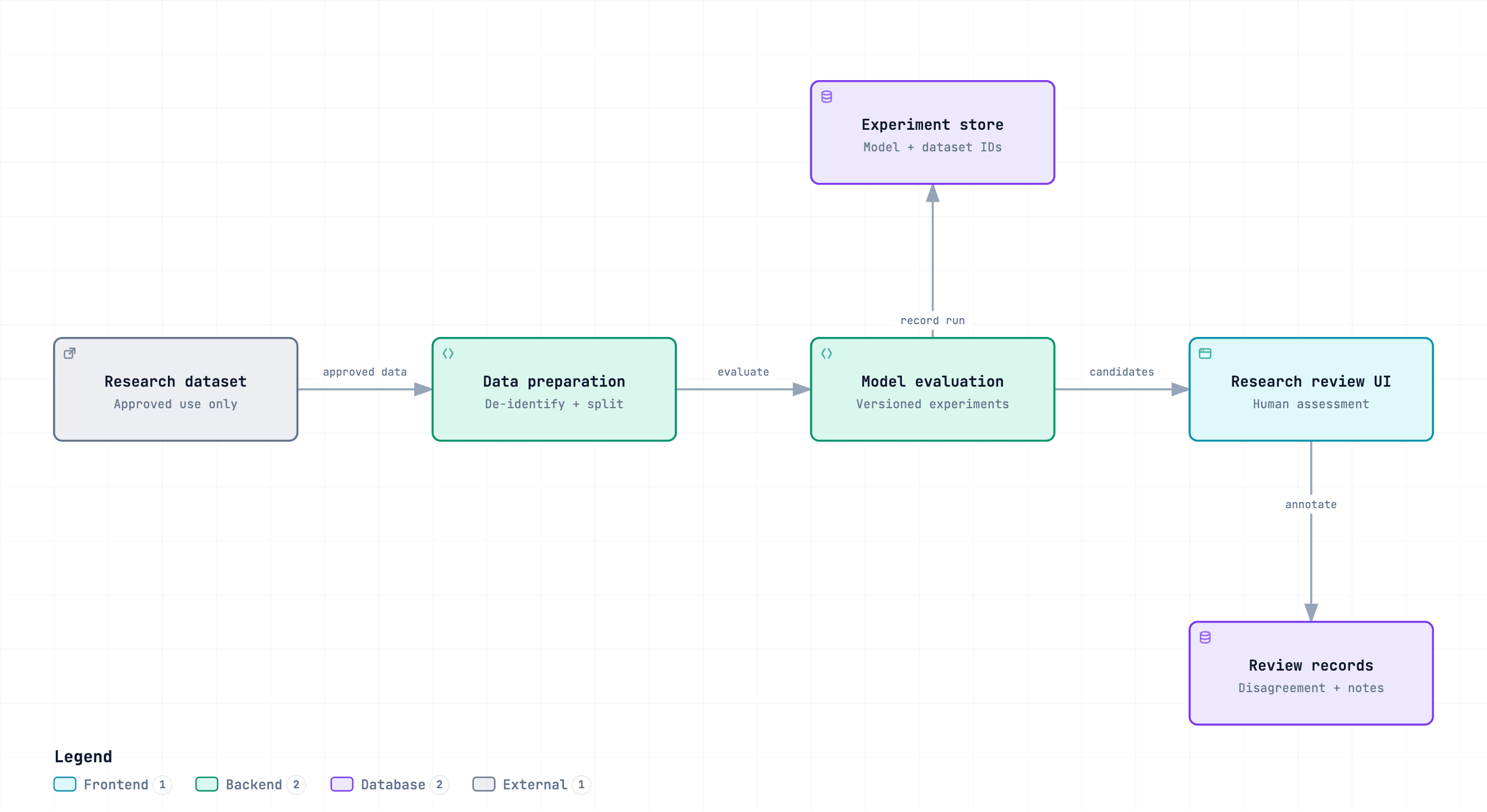
- Research data pipelines
- Model evaluation
- Review tooling
Delivery model
A bounded research prototype with human review
Client decisions and discovery
The research lead defines the evaluation question. The data owner confirms permitted use, access and any required approvals before data is provided.
BCT implementation responsibilities
The BA and data engineer document dataset provenance and preparation. Engineers build the review workflow; QA verifies dataset separation, access controls and reproducible evaluation outputs.
Review gates and scope boundaries
Use only data cleared for the agreed purpose. Record limitations and reviewer disagreement. The research prototype scope excludes clinical deployment, treatment decisions and autonomous diagnosis.
Key design decision
Separate research evaluation from clinical decisions. Track dataset and model versions, reserve evaluation data and record reviewer disagreement. This prototype has no path to clinical treatment or autonomous diagnosis.
Delivery artifacts
Agree these outputs during scoping, then review them alongside the acceptance checks below.
- Dataset-use register, preparation workflow and evaluation split
- Versioned experiment results with error and subgroup analysis
- Research review prototype with human annotations and documented limitations
How to evaluate delivery
- Verify role-based access and traceability of review actions.
- Record usability feedback without treating it as diagnostic validation.
- Keep the prototype separate from clinical operations unless separately authorised.