
Solution Overview
This solution covers a portal for submitting and reviewing applications. The aim is to clarify user journeys and operational ownership before replacing modules.
The Challenge
Questions to resolve before committing to scope:
- Which applications and supporting documents are in scope?
- How do staff request corrections and communicate status?
- Which access, retention and accessibility requirements must be agreed?
Delivery approach
- Map user and staff journeys: Review forms, decision points and handoffs; choose a bounded service for the first release.
- Build and test one workflow: Prototype submission, correction and status tracking; review keyboard operation and error handling.
- Migrate and hand over: Rehearse data migration and rollback, prepare staff guidance and agree on support ownership.
Inside the solution
From workflow to system design
- Workflow development
- Access control
- Legacy integration
Delivery model
Application development, replacing one application procedure first
Client decisions and discovery
The procedure owner explains eligibility, review and exception handling. The system owner confirms interfaces, retention, accessibility and security requirements for the intended setting.
BCT implementation responsibilities
The BA interviews users and reviewers and maps current forms. The architect defines the legacy boundary. Engineers implement state transitions; QA verifies permissions, keyboard use and migrated records.
Review gates and scope boundaries
Agree requirements and evidence with the client before expanding to other procedures. Confirm applicable procurement requirements and the responsibilities of each organisation before starting work.
Key design decision
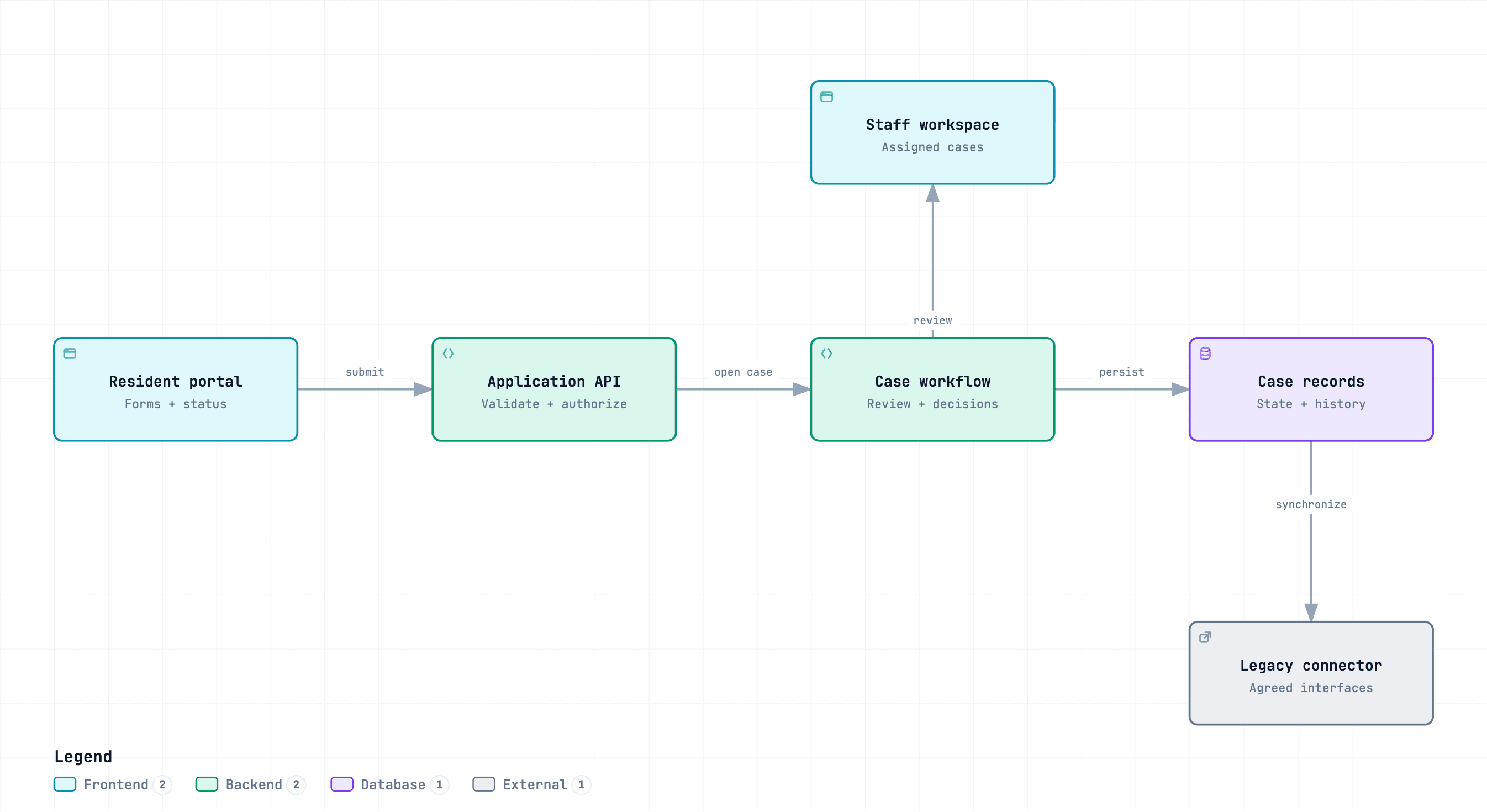
Model the application as explicit states with role-based transitions. Keep a decision history and a legacy integration boundary so one procedure can be replaced and reviewed before expanding to other services.
Delivery artifacts
Agree these outputs during scoping, then review them alongside the acceptance checks below.
- Procedure map, role matrix and accessible form prototype
- Case workflow with status history and integration contracts
- Keyboard-navigation, permission and migration test records
How to evaluate delivery
- Trace an application from submission through staff review.
- Check agreed accessibility criteria with automated and manual testing.
- Reconcile migrated records and document operational responsibilities.