
Solution Overview
We connect equipment readings and production records to support factory operations. Starting with one production line lets the team check data quality before extending coverage.
The Challenge
Questions to resolve before committing to scope:
- Which equipment exposes usable data, and who owns access?
- How are downtime and production counts defined?
- What must remain available when connectivity is lost?
Delivery approach
- Map the production workflow: Review sample records with operators and agree on data definitions and a pilot boundary.
- Build and review a pilot: Connect an agreed data source to a dashboard; make missing or delayed readings visible during operator reviews.
- Prepare operational handover: Test reconnect behaviour, document alert ownership and plan rollout line by line.
Inside the solution
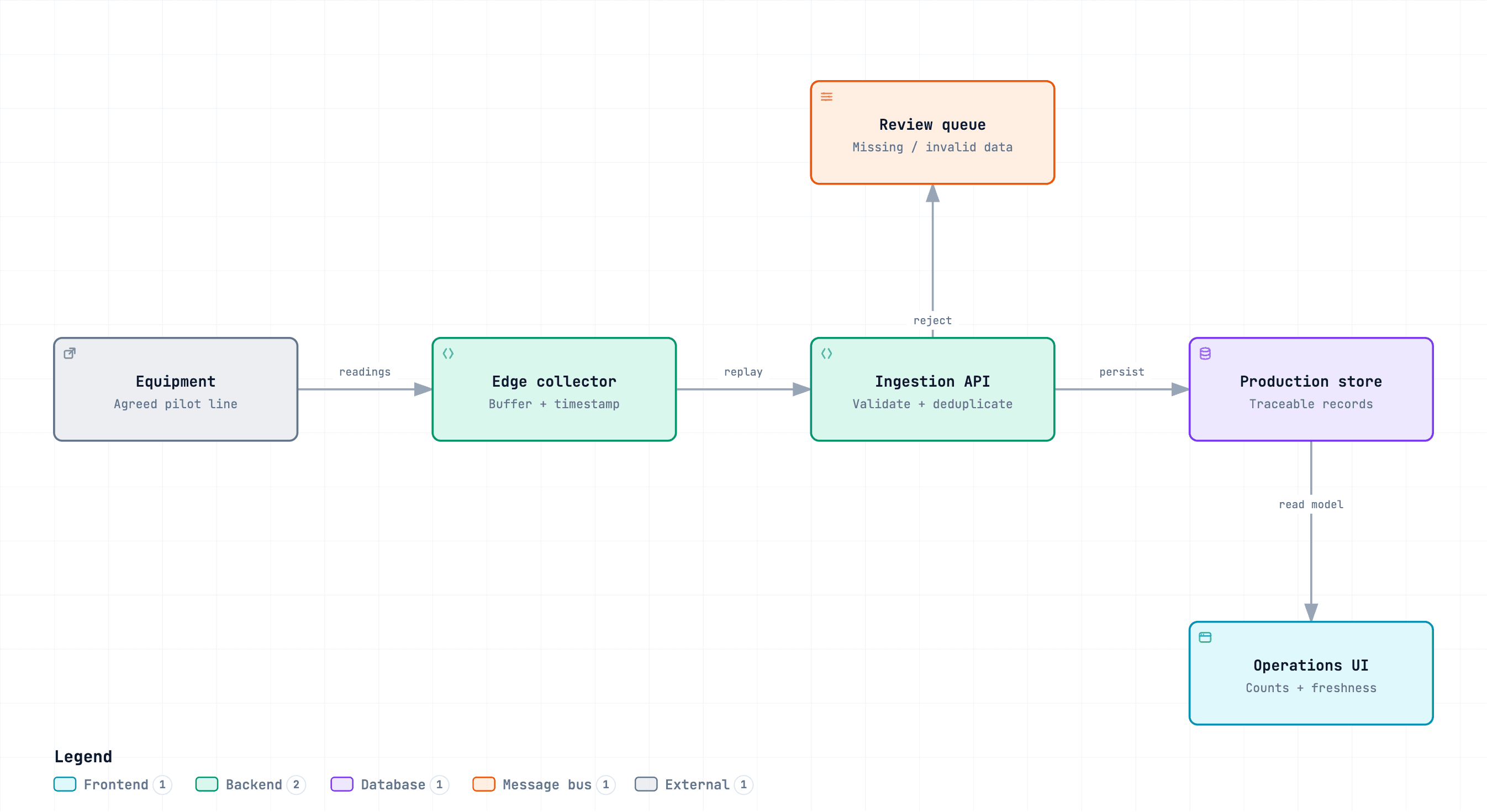
From workflow to system design
- Data ingestion
- Operational dashboards
- Recovery testing
Delivery model
Application development, starting with a single-line pilot
Client decisions and discovery
The production owner defines downtime and output measures. Operators explain exceptions, while the equipment owner approves connectivity and access.
BCT implementation responsibilities
A BA interviews operators and maps sample records. The architect checks device protocols and failure modes. Engineers implement the ingestion flow; QA reconciles source records and tests disconnect and replay behaviour.
Review gates and scope boundaries
Review the pilot with the production owner before connecting further equipment. Agree acceptable data delay, maintenance windows and who responds to missing readings.
Key design decision
Buffer readings close to the equipment, then validate timestamps and deduplicate at ingestion. Keep rejected readings visible so a healthy-looking dashboard cannot hide missing source data.
Delivery artifacts
Agree these outputs during scoping, then review them alongside the acceptance checks below.
- Source-to-field mapping and a pilot-line integration
- Dashboard with data-freshness and missing-data states
- Replay test report, alert ownership and an operator runbook
How to evaluate delivery
- Reconcile dashboard totals with the source records.
- Check how missing readings and network outages are reported.
- Agree on a baseline for reporting effort before assessing improvement.