
Solution Overview
This solution brings shipment events and dispatch tasks into a shared operational view. A limited route or service area can be used to validate event quality and user workflows before broader rollout.
The Challenge
Questions to resolve before committing to scope:
- Which system owns shipment and vehicle records?
- How should offline, late or out-of-order updates be handled?
- Who resolves delivery exceptions and corrects inaccurate events?
Delivery approach
- Define events and responsibilities: Agree on shipment statuses, data sources and the owner of each operational action.
- Pilot the operational view: Build event intake and a dispatcher view; review exception cases with the operations team.
- Test resilience and expand: Test delayed updates and reconnect behaviour, then agree on support procedures and rollout boundaries.
Inside the solution
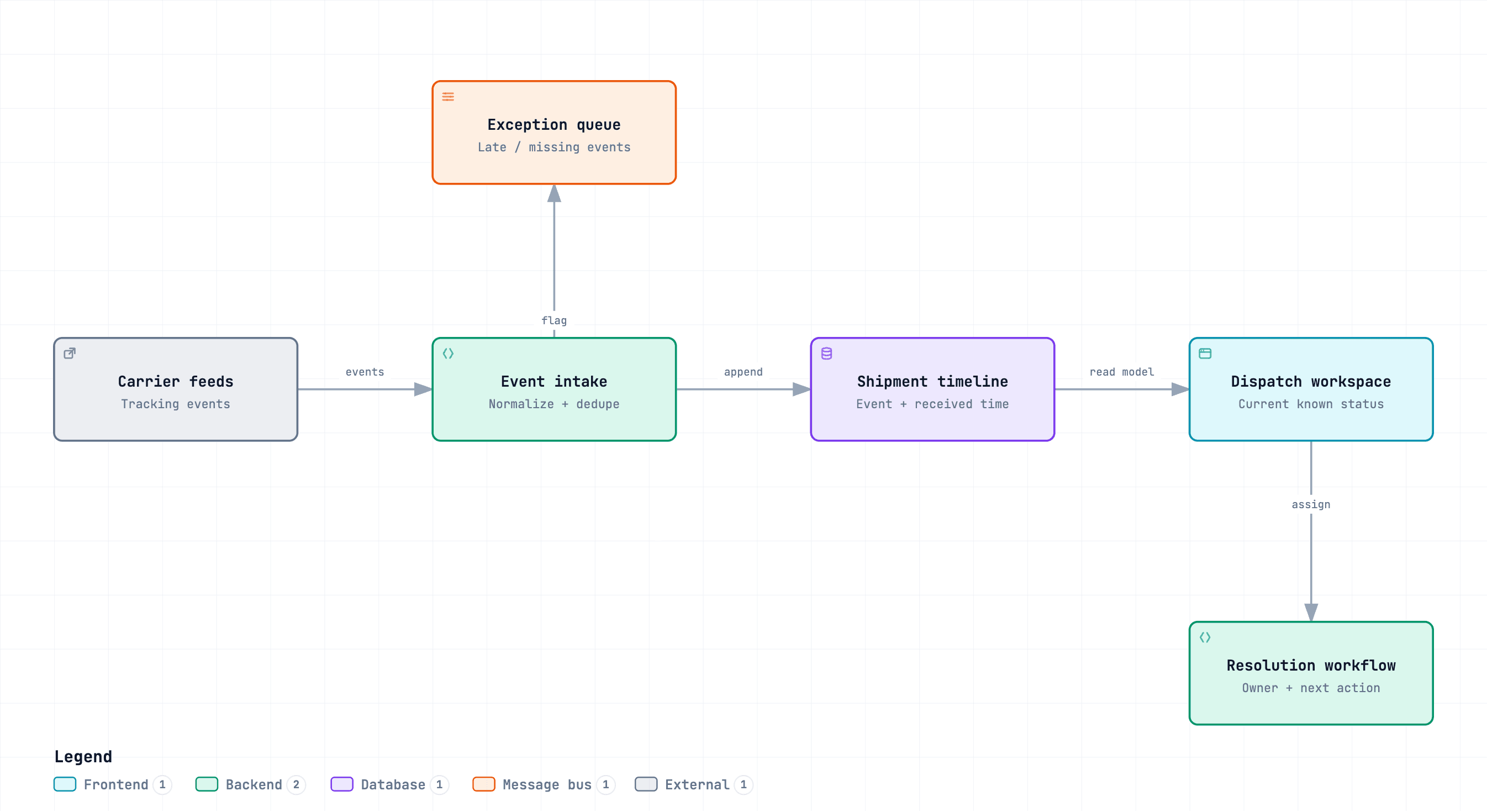
From workflow to system design
- Event integration
- Dispatch tooling
- Exception handling
Delivery model
Dedicated team, starting with one carrier integration
Client decisions and discovery
The operations owner prioritises exceptions and confirms shipment-state definitions. Dispatchers review the proposed interface; carrier contacts confirm event contracts.
BCT implementation responsibilities
The BA observes dispatch workflows. Engineers integrate carrier events and build the dispatch view. QA replays delayed, duplicated and out-of-order events against the agreed state model.
Review gates and scope boundaries
Review each increment with dispatchers and the product owner. Confirm who handles unresolved exceptions, how long event history is kept and which location data each role may access.
Key design decision
Preserve event time and receipt time separately. Deduplicate updates and flag late events before changing the visible shipment state. Dispatchers need the source and freshness of each update, plus an owner for unresolved exceptions.
Delivery artifacts
Agree these outputs during scoping, then review them alongside the acceptance checks below.
- Carrier event contracts and a normalized shipment-event model
- Dispatch view with freshness, source and exception states
- Out-of-order replay tests and exception-response runbook
How to evaluate delivery
- Reconcile displayed status with the shipment event history.
- Test repeated, delayed and out-of-order events.
- Measure dispatch effort and exception resolution against an agreed baseline.